
How to Replace Safety Contactors Correctly
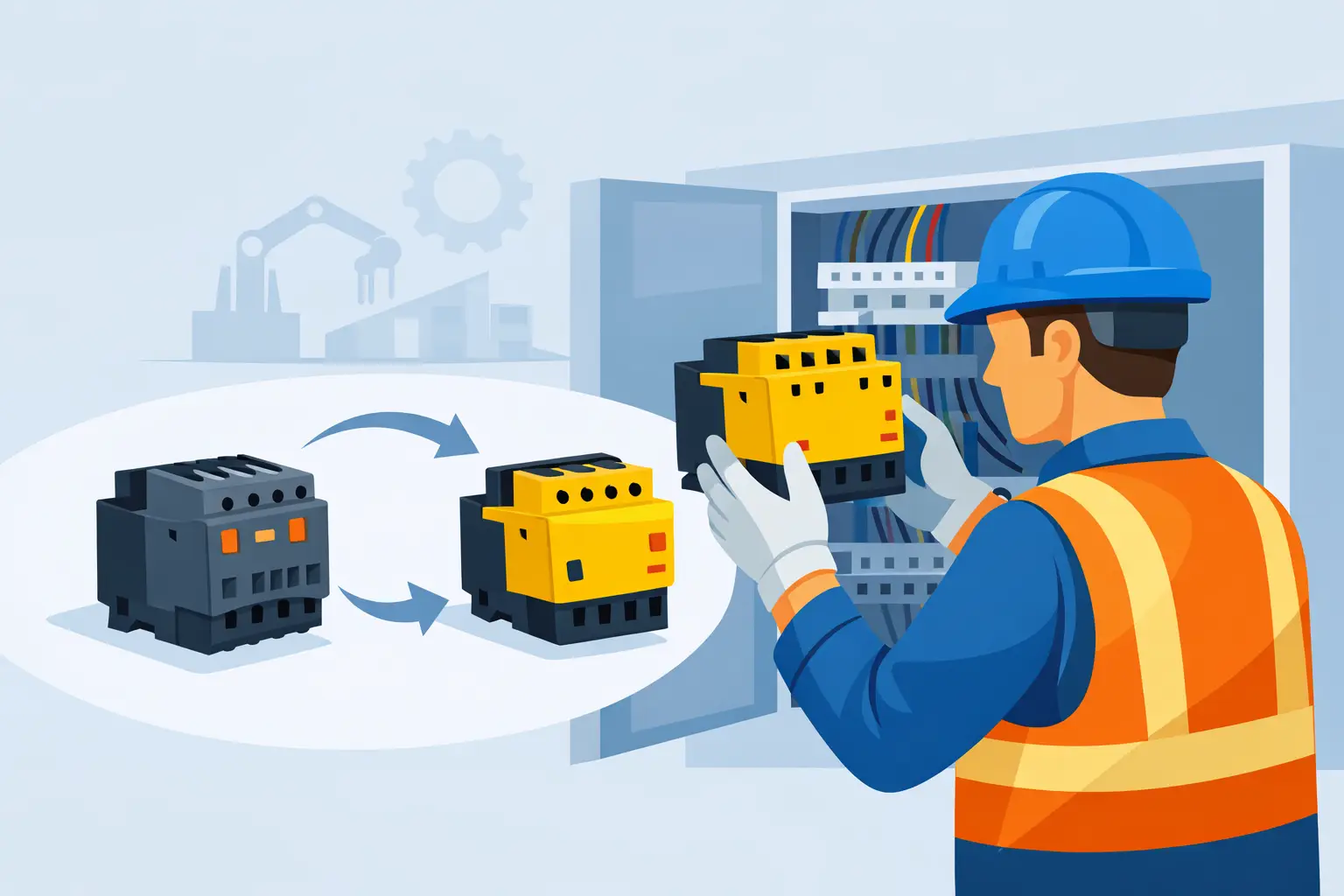
A safety contactor rarely fails at a convenient time. When it drops out unexpectedly, welds closed, or starts showing inconsistent auxiliary feedback, the pressure is immediate - restore the machine, protect personnel, and avoid creating a bigger problem during the repair. If you need to know how to replace safety contactors, the job starts with identification and verification, not with pulling wires.
Unlike a standard power contactor, a safety contactor is part of a validated safety function. That changes the replacement process. You are not only swapping a component. You are restoring a circuit that may be tied to an E-stop chain, guard interlocks, safety relays, or safety controllers. A quick visual match is not enough if the contact arrangement, coil voltage, mirror contacts, or mechanical characteristics differ.
How to replace safety contactors without creating new faults
The first decision is whether the contactor is actually the failed device. In many panels, a safety contactor is blamed because the machine will not reset, but the root cause is elsewhere - a failed safety relay output, a door switch not returning, low control voltage, a damaged suppressor, or an overload event upstream. Before replacement, confirm the symptom. Check whether the coil is receiving the correct control voltage, whether the main poles are opening and closing as expected, and whether the feedback loop is returning the right state to the safety circuit.
If the contactor has visible overheating, melted housing, welded contacts, excessive chatter, or a failed mechanically linked auxiliary block, replacement is usually justified. If the issue is intermittent, check terminal tightness and control power quality before you pull the unit. Replacing the wrong part costs time and can leave the actual fault in place.
Start with the exact part number
For industrial buyers and maintenance teams, the fastest route is the manufacturer part number on the device nameplate or assembly documentation. Safety contactors from Siemens, Schneider Electric, ABB, Allen-Bradley, Omron, Mitsubishi, and other major brands can look similar across families, but small differences matter. Coil code, contact configuration, frame size, terminal style, and approved accessory combinations must line up.
If the original part number is obsolete, do not assume the nearest catalog match is acceptable. Check the manufacturer replacement path or engineering documentation for the machine. In safety circuits, a newer substitute may be valid, but only if it preserves the required electrical and functional characteristics.
Verify the specifications that matter
When replacing a safety contactor, focus on the details that affect both operation and safety validation. Coil voltage is the first checkpoint. A 24 V DC coil, 120 V AC coil, and 230 V AC coil may exist in the same product family with nearly identical housings.
Next, confirm the power contact arrangement and current rating. A three-pole unit switching motor loads is not interchangeable with a similar frame intended for lighter duty if the application category is different. AC-3 motor switching, resistive loads, and frequent cycling all affect selection.
Auxiliary contacts deserve extra attention. In many safety circuits, mirror contacts or mechanically linked contacts are used for external device monitoring. If the replacement contactor does not provide the same feedback characteristics, the machine may not reset, or worse, it may no longer meet the intended safety behavior.
Also verify terminal style and mounting. DIN rail and panel-mounted units may require different clearances or accessory kits. A replacement that technically matches electrically but does not fit the enclosure cleanly can turn a short repair into panel rework.
Safe removal and installation steps
Once you have confirmed the correct replacement, isolate all energy sources according to site lockout/tagout procedures. That includes line power, control power, and any stored energy in associated circuits. Safety contactors are often tied into multiple control layers, so verify zero energy rather than assuming a single disconnect covers the entire panel.
Document the existing wiring before removal. A few clear photos help, but they should not replace wire markers or terminal-by-terminal documentation. On older machines, field changes are common, and the as-built wiring may not match the original prints exactly.
Remove the failed contactor carefully, especially if add-on auxiliary blocks, surge suppressors, or interlock accessories are attached. Those accessories may need to move with the replacement, or they may also need replacement if heat damage or age is evident. If a suppression module failed short or open, replacing only the contactor can result in repeat failure.
Install the new contactor with the correct torque on all terminals. Loose terminations are a common source of heat, voltage drop, nuisance trips, and early component failure. If the application uses ferrules, ring lugs, or specific conductor preparation methods, follow the panel standard and manufacturer guidance.
Check the feedback loop before startup
After wiring is complete, do not go straight to production. Safety contactors often work in pairs or in monitored arrangements where auxiliary feedback must change state correctly before the safety relay or controller allows reset. Verify the state of the main contacts and the feedback contacts with the contactor de-energized and energized.
This is where incorrect replacements often show up. The contactor may pull in, but the monitored feedback chain does not close properly, leaving the machine in a no-reset condition. That usually means the auxiliary arrangement, contact block orientation, or wiring transfer is wrong.
Common replacement mistakes
The most common error is treating a safety contactor like a standard contactor. The second is selecting by appearance instead of part number and ratings. Both create avoidable downtime.
Another frequent issue is overlooking coil type. AC and DC coils behave differently, and the wrong coil can fail immediately or operate unreliably. Mixing accessories from different series is also risky. An auxiliary block that physically clips on does not always provide the approved mechanical linkage or contact performance the original design requires.
Legacy equipment adds another complication. Older machines may use discontinued safety contactors with hard-to-find auxiliary modules. In those cases, the right answer depends on the application. Sometimes a direct legacy replacement is still available through an inventory supplier. In other cases, engineering review is needed to move to a current series without changing the safety function.
When a direct replacement is not available
If the exact part number is unavailable, slow down and verify the replacement path. Match the manufacturer, series compatibility, coil voltage, main contact rating, auxiliary contact function, and accessory stack. Review the schematic and the safety logic. In some plants, procurement teams try to standardize across brands to simplify stocking. That can work for general control hardware, but safety contactors are not a category where cross-brand substitution should happen casually.
A technically similar unit from another brand may still require changes to mounting, wiring, terminal markers, spacing, short-circuit protective device coordination, and safety validation. If the machine was originally assessed around a specific contactor family with mirror contacts and monitored response, any change should be reviewed by the responsible engineer.
Sourcing the replacement fast
For most maintenance and procurement teams, the practical challenge is not understanding the swap - it is finding the exact part fast enough to support uptime. That is why part-number-driven sourcing matters. Search by the full catalog number, including suffixes for coil voltage and terminal style. If the unit includes factory-installed auxiliary contacts or interlocks, include those details in the request.
If you are buying for critical spares, it also makes sense to check adjacent components at the same time. Overloads, suppressors, auxiliary blocks, and safety relays often age together in high-cycle applications. A single order that covers the full repair set reduces the chance of repeat downtime a week later.
For buyers managing mixed-brand facilities, a centralized source can simplify that process. American Automation 24 supports cross-brand replacement sourcing so maintenance teams can identify exact automation parts, verify availability, and keep purchasing moving without opening separate channels for every manufacturer.
Final checks after replacement
Before releasing the machine, test the safety function under controlled conditions. Confirm that the contactor energizes and drops out correctly, that the monitored feedback behaves as expected, and that the machine resets only under the proper conditions. Verify normal stopping and safety stopping behavior separately if the machine design calls for both.
Then update the maintenance record with the installed part number, date, and observed failure mode. That small step helps the next buyer or technician know whether the issue was wear, overload, heat, contamination, or a control-side fault. Over time, that record is what turns emergency replacement into planned reliability work.
A safety contactor replacement should restore more than machine operation. It should restore the intended control behavior with the right part, the right wiring, and the right verification so the next startup is routine instead of uncertain.