
Machine Safety Device Selection Guide for Plants
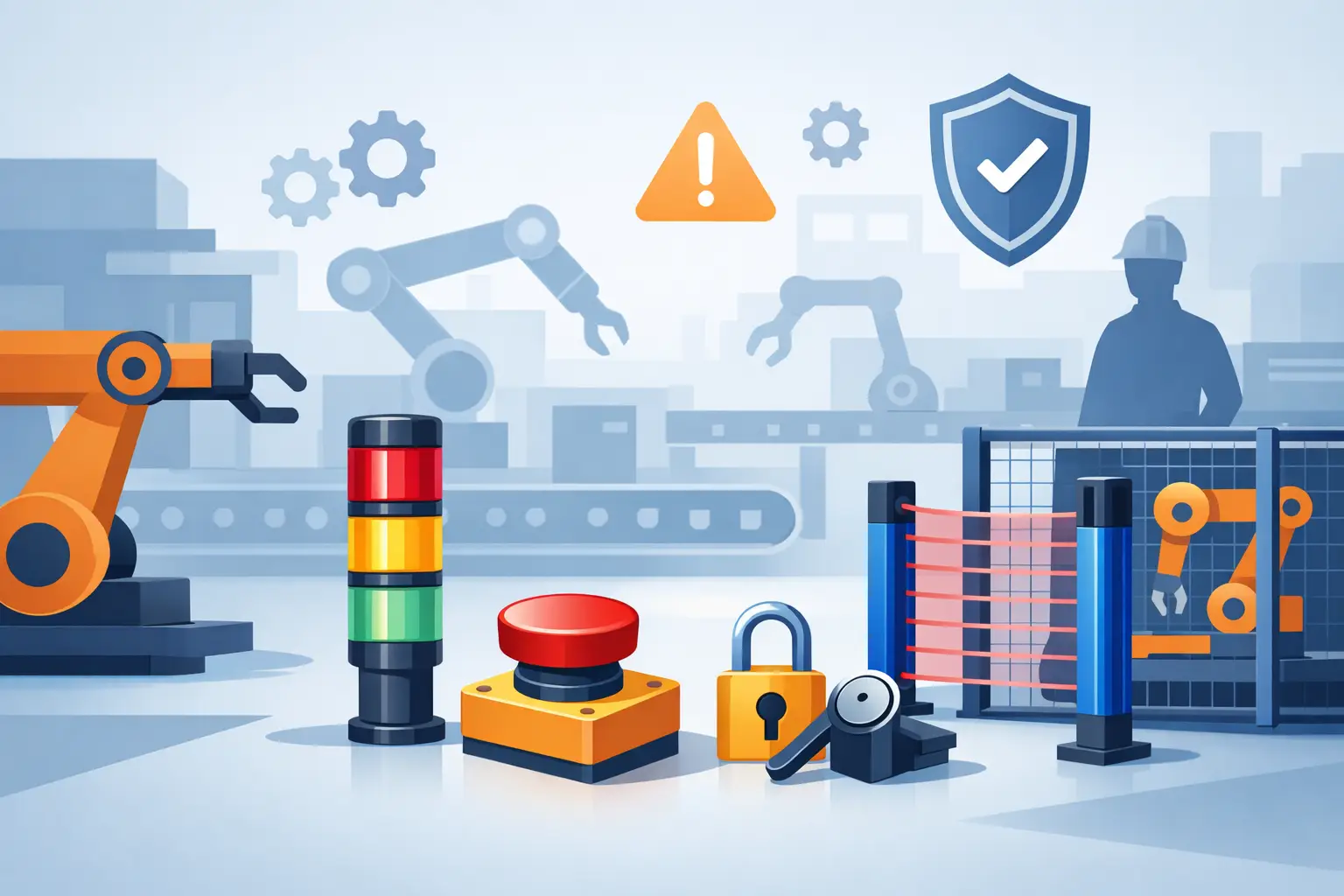
A machine safety device selection guide is most useful when it starts with the hazard, not a catalog category. A light curtain, interlock switch, safety relay, or emergency-stop device may all be appropriate on the same production line, but each addresses a different part of the risk. Selecting by price, mounting convenience, or a familiar part number can leave a gap between the installed device and the protection the machine actually requires.
For maintenance managers, controls engineers, and buyers, the objective is straightforward: identify the safety function, select compatible components, verify the required performance, and keep the equipment supportable over its service life. That process reduces both personnel risk and the costly delays that follow an incorrect replacement or incomplete retrofit.
Start With the Machine Hazard and Task
The right device depends on what can cause injury, who can reach it, and when access is needed. A fixed guard may be the correct answer for a hazard that never requires routine access. A movable guard with an interlock is more suitable when operators need to load material, clear minor jams, or make adjustments. Where access is frequent and no physical barrier is practical, presence-sensing devices such as safety light curtains or laser scanners may be considered.
Do not assess normal production only. Include setup, cleaning, changeover, troubleshooting, tool replacement, and jam clearing. These are the conditions where personnel often bypass a poorly designed guard or where an otherwise suitable safety device proves impractical.
A documented risk assessment should identify the hazard source, the possible injury, frequency and duration of exposure, access route, and the machine stopping behavior. US facilities also need to account for applicable OSHA requirements, while machine builders and integrators commonly use risk-assessment and functional-safety methods based on standards such as ISO 12100, ISO 13849-1, or IEC 62061. The governing requirement depends on the equipment, application, customer specification, and jurisdiction.
Define the Safety Function Before Choosing a Device
A safety device is one component in a safety function. The function could be: opening the guard door stops hazardous motion and prevents restart while the door is open. Or: interruption of the light curtain stops the press before a person can reach the danger zone.
Writing the function in plain language exposes missing details. What initiates the stop? Which contactors, drives, valves, or motion axes must reach a safe state? Does the machine need a controlled stop before power is removed? Can it restart automatically after the device resets, or must an operator deliberately reset the system from a safe location?
This step also separates emergency-stop functions from safeguarding functions. An emergency-stop device provides a manual means to stop or avert an emergency. It does not replace perimeter guarding, interlocked access doors, two-hand controls, or presence sensing. Likewise, a standard proximity sensor may provide useful position feedback, but it is not automatically suitable for a safety-rated guard-monitoring function.
Match the Device Type to the Access Method
Once the safety function is clear, the choice becomes more focused.
Fixed and Interlocked Guards
Fixed guards are generally simple, durable, and effective where routine access is not needed. Their limitations are operational: if a technician must remove a guard repeatedly to complete normal work, the design invites workarounds.
For movable guards, select an interlock type based on the door construction, alignment tolerance, environment, and required tamper resistance. Tongue-operated switches can work well on aligned hinged doors but may be more vulnerable to misalignment or defeat than coded RFID-style switches. Non-contact coded interlocks are useful where vibration, washdown, or door sag makes mechanical alignment difficult.
Guard locking is a separate decision. Use it when the hazard remains after a stop command, such as a high-inertia spindle, coasting conveyor, stored pneumatic energy, or elevated temperature. The lock release method matters. Power-to-release and power-to-lock approaches have different behavior during a power loss, so the choice must follow the risk assessment and evacuation needs rather than a default preference.
Light Curtains, Safety Scanners, and Safety Mats
Optoelectronic protection is effective when operators must feed, unload, or observe a process without opening a physical guard. The critical issue is not simply sensing a person. It is preventing a person from reaching the hazard before motion stops.
For light curtains, resolution affects what can be detected, while protective height and mounting position determine the coverage. Minimum safety distance must account for total stopping time, response time of the safety system, approach speed, and the relevant calculation method. A curtain mounted too close to the hazard can be fully functional electrically and still fail its protective purpose.
Safety laser scanners can protect irregular zones, mobile equipment interfaces, and areas where physical guarding is difficult. They require careful zoning, field configuration, contamination management, and verification after changes. Safety mats may fit defined standing areas, but they need protection from damage, product accumulation, and unintended activation.
Two-Hand Controls and Enabling Devices
Two-hand controls are appropriate only for certain operations where both of an operator's hands must be kept clear during a hazardous cycle. They do not protect other people who may enter the area, and they do not eliminate the need to address side or rear access.
Enabling devices are used during setup, teach, and maintenance tasks where reduced-speed operation or limited motion must be performed with a person inside a safeguarded area. A three-position enabling switch is common because it requires a deliberate middle position. The surrounding control architecture must still ensure that speed, motion, and restart behavior remain appropriate for the task.
Verify the Safety Architecture and Performance Level
A safety-rated input device must connect to a safety-rated control system that can detect faults and bring the machine to its defined safe state. This may include a configurable safety relay, safety controller, safety PLC, safety-rated drive function, or a combination of these elements.
Device compatibility involves more than voltage and connector style. Confirm the input type, dual-channel wiring requirements, test-pulse compatibility, output type, reset circuit, feedback loop or external device monitoring, and the number of safety zones required. A replacement device that appears electrically similar may not provide the same diagnostic coverage, coding level, or fault-detection behavior.
The required Performance Level, commonly expressed as PLr, or Safety Integrity Level target should be established during the risk assessment. The final design must be validated as a complete function. That includes the sensor or switch, logic solver, output devices, wiring, stopping performance, and reset arrangement. A component data sheet alone cannot prove that the completed machine circuit meets the intended target.
Consider the Conditions That Cause Field Failures
Industrial safety components are often selected for their functional rating and then installed in conditions that shorten service life. Review the real operating environment before finalizing a part number. Washdown, cutting fluids, weld spatter, dust, vibration, temperature swings, cable flexing, and outdoor exposure can all change the appropriate enclosure rating, housing material, actuator style, and connector choice.
For guarded doors, check mechanical realities: door travel, hinge wear, stop position, guard rigidity, and the ability to maintain alignment after thousands of cycles. For light curtains and scanners, consider contamination, reflective surfaces, direct sunlight, and routine cleaning access. For emergency-stop devices, confirm visibility, mounting location, contact configuration, and whether the application needs a twist release, key release, or another reset method.
Replacement planning matters as well. Record the full manufacturer part number, actuator or accessory part number, wiring configuration, controller input assignment, and safety-circuit documentation. This prevents a failed interlock, relay, or sensor from becoming a multi-day identification exercise during an outage.
Build Procurement Around Exact Requirements
When sourcing a safety component, start with the approved specification rather than a broad product label. “Safety switch” is not enough information for a buyer or supplier to confirm a suitable item. Provide the manufacturer and exact model when available, plus the required voltage, contact or OSSD configuration, connector type, actuator style, environmental rating, and safety-control platform.
For legacy equipment, confirm whether the original part is still available, superseded, or requires an engineered replacement. A newer device may require a different actuator, mounting bracket, mating cable, controller configuration, or validation process. Substituting parts without checking these details can create downtime and may alter the documented safety function.
American Automation 24 can help buyers locate branded automation and control components across multiple manufacturer lines, but the final selection should remain tied to the machine's risk assessment, electrical drawings, and validation requirements. Procurement speed is valuable only when the part received is correct for the installed system.
Treat Validation and Maintenance as Part of Selection
A device is not fully selected when the purchase order is placed. Before returning equipment to service, verify mounting, wiring, stopping behavior, reset location, fault response, and prevention of unexpected restart. Test each access point and protective field under the conditions defined by the safety function.
Set inspection intervals based on the device type and operating conditions. Look for loose actuators, damaged cables, defeated interlocks, contaminated lenses, misaligned guards, slow stopping times, and repeated diagnostic faults. If operators frequently report nuisance trips, investigate the cause. Repeated bypassing is usually evidence that the safeguarding design and the production task are not working together.
The most dependable machine safety choice is rarely the device with the longest feature list. It is the correctly specified, properly integrated component that protects the actual access path, fits the way the machine is operated, and can be identified quickly when maintenance needs a replacement.