
New Versus Surplus Automation Parts for Uptime
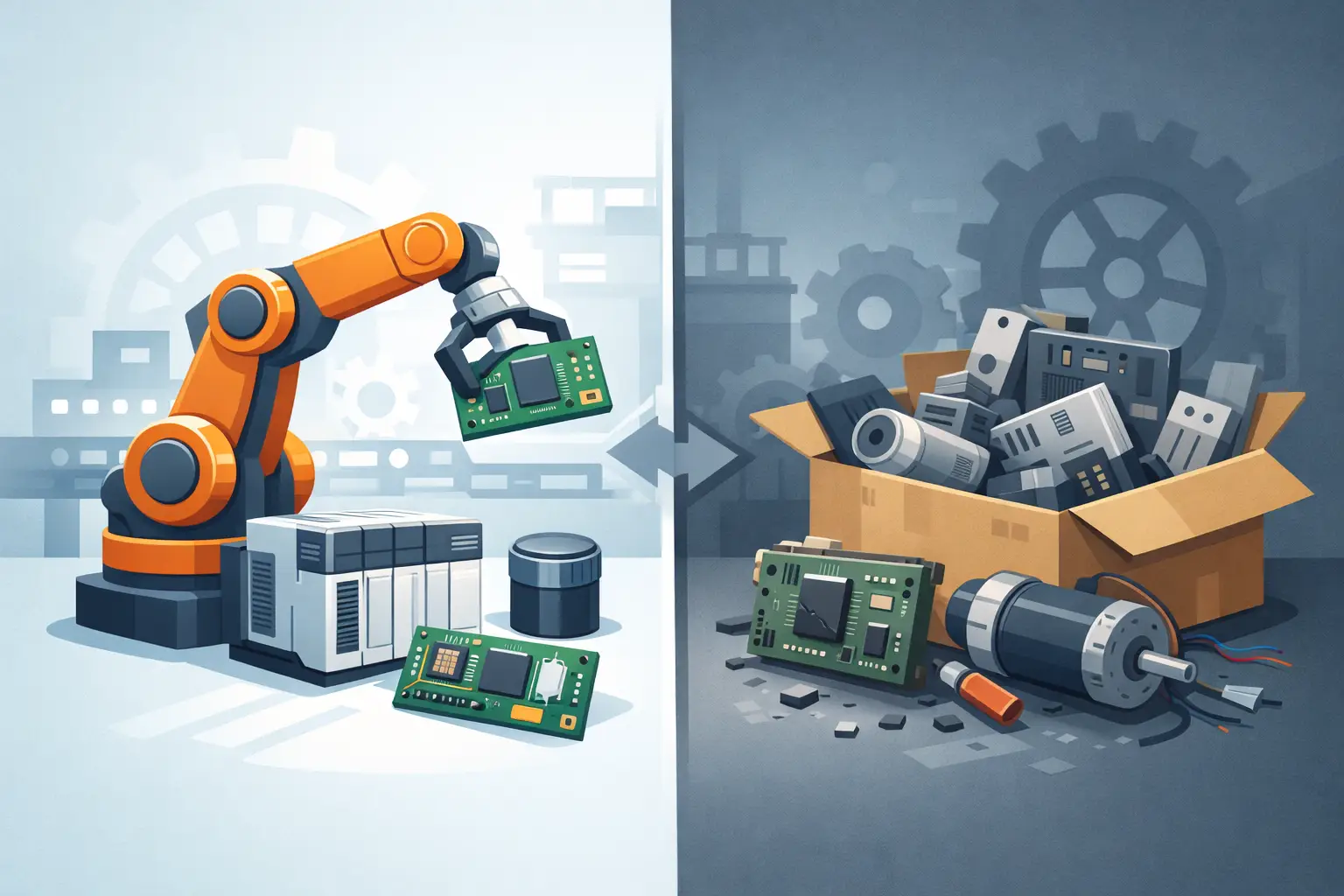
A failed PLC input module, servo drive, or photoelectric sensor rarely arrives at a convenient time. When production is waiting, the decision between new versus surplus automation parts is not simply about unit price. It is a purchasing decision that affects startup timing, replacement compatibility, maintenance risk, and the ability to keep a critical machine in service.
For many industrial buyers, both options have a place. The correct choice depends on the application, the part’s condition and history, the level of support required, and the cost of an additional failure. A clear evaluation process helps maintenance and procurement teams buy with confidence instead of reacting to a shortage or an urgent breakdown.
What “New” and “Surplus” Actually Mean
A new automation part is generally supplied as unused product from current or recent manufacturer distribution channels. It is typically delivered in original packaging, carries standard manufacturer documentation where applicable, and may include the manufacturer’s warranty. For active product lines, new stock is usually the lowest-risk option when lead time and budget allow.
Surplus parts are unused components that have entered the secondary market. They may come from excess project inventory, plant closures, canceled machine builds, inventory reductions, or discontinued product holdings. A surplus Allen-Bradley controller, Siemens HMI, Omron sensor, or ABB drive may be factory-sealed and never installed, but it is not automatically equivalent to newly sourced authorized-channel stock.
That distinction matters. “Surplus” describes the supply path, not a single condition grade. One item may be unopened in original packaging; another may have opened packaging, an older date code, or incomplete accessories. Buyers should verify the condition listed for the exact SKU rather than relying on the category name alone.
New Versus Surplus Automation Parts: The Decision Factors
The right procurement choice begins with the role the component plays in the operation. A noncritical sensor used in a redundant position has a different risk profile from a safety-related component, a motion controller, or a processor that can stop an entire packaging line.
Condition, packaging, and identification
Exact part-number confirmation comes first. Compare the complete manufacturer number, including suffixes, voltage ratings, communication versions, firmware considerations, and connector or mounting variations. A base number can look correct while a suffix identifies a materially different product.
For surplus stock, ask whether the unit is factory sealed, new in box, open box, or tested. Confirm that labels are legible and that the manufacturer number on the device matches the ordered part number. For items that require accessories, such as terminals, memory cards, interface modules, fans, cables, or mounting hardware, verify what is included before placing the order.
Original packaging is useful, but it is not the only indicator of condition. Packaging can deteriorate in storage, and an unopened box does not confirm appropriate storage conditions. A professional supplier should be able to clearly state the listed condition and assist with product identification questions before shipment.
Warranty and return requirements
New parts may carry a manufacturer warranty, subject to the manufacturer’s terms and distribution channel. Surplus parts commonly carry a supplier warranty instead. Neither should be treated as a minor detail when the component is intended for a critical asset.
Review the warranty length, what it covers, the return process, and whether the supplier offers support if an item arrives damaged or does not match the order. Procurement teams should also document these terms in the purchase record. If a replacement will require a shutdown, lift rental, programming labor, or outside service support, the cost of a weak warranty can exceed the purchase savings quickly.
Lead time and availability
Availability is often the main advantage of surplus inventory. A current-production component may have an extended factory lead time, while surplus stock may be ready to ship. This is particularly relevant for legacy PLC hardware, obsolete operator interfaces, discontinued drives, and sensors used in machines that are still productive but no longer supported by the original product line.
New stock remains preferable when it can be obtained quickly and the part is available through a standard channel. It provides greater consistency for planned maintenance, new machine builds, and long-term standardization. However, when a line is down and the exact legacy part is unavailable from the manufacturer, surplus may be the most practical path to production recovery.
The key is to separate an urgent replacement from a long-term maintenance strategy. A surplus part can restore a line now, while engineering evaluates an upgrade plan that removes future dependence on aging hardware.
Application criticality and failure consequences
Not all parts deserve the same purchasing threshold. Consider the operational result if the item fails immediately, fails after several months, or is delayed in transit. Components tied to personnel safety, regulated processes, high-speed motion, or a single point of production failure generally warrant stricter sourcing requirements.
For a safety relay, safety controller, critical VFD, PLC CPU, or motion drive, many facilities will favor new stock, current documentation, and manufacturer-backed support. For a mature but stable machine using a discontinued I/O card or HMI, verified surplus stock can be a sensible choice, especially when replacing the platform is not yet justified.
This is an engineering and risk decision, not a blanket rule. The part price is only one line in the total cost of downtime.
Where Surplus Parts Provide Real Value
Surplus inventory is especially useful in facilities with mixed automation platforms and long machine lifecycles. Packaging lines, material-handling systems, process equipment, and custom machinery may run for decades. The installed controls can remain reliable long after a manufacturer transitions to a newer generation.
In those cases, buying a compatible surplus replacement can avoid immediate redesign work, cabinet modifications, program conversion, revalidation, and operator retraining. An exact replacement can also reduce the time required to return equipment to service compared with an upgrade that requires engineering approval.
Surplus stock can also help build targeted spares. If a plant has several machines using the same obsolete power supply, processor, encoder, or communication module, maintaining one or two verified spares may be more economical than accepting an unplanned search during a failure. The objective is not to overstock every component. It is to identify parts with a high downtime impact and a limited replacement path.
Risks to Manage Before Buying Surplus
Surplus purchasing requires disciplined verification. Older electronic products can be affected by storage conditions, battery age, capacitor aging, corrosion, electrostatic handling, or outdated firmware. These risks are not reasons to avoid surplus altogether, but they are reasons to evaluate the supplier and the item carefully.
Before issuing a purchase order, confirm the exact manufacturer number and quantity, the item condition, whether it is available to ship, and the stated warranty. For high-value components, document photos, serial information when appropriate, and any required testing or inspection criteria. If the part is intended for a controlled or validated process, involve engineering and quality before the order is released.
Counterfeit risk also requires attention, particularly for high-demand semiconductor-containing controls and components that are difficult to source. Be cautious of pricing that is far below normal market expectations, vague condition descriptions, altered labels, or suppliers that cannot answer basic part-identification questions. Clear product descriptions, accountable customer support, and established order records provide a better foundation for industrial purchasing.
Build a Practical Sourcing Standard
The most effective approach is to set purchasing rules before the next failure. Maintenance, controls engineering, and procurement should agree on which parts must be new, which can be sourced as verified surplus, and which should trigger an upgrade review.
A useful standard classifies components by criticality, availability, and replacement complexity. A commonly available 24 VDC power supply may need only a standard reorder point. A discontinued PLC processor with custom programming may require an on-site spare and a documented migration plan. A safety component may require new stock and specific approval requirements regardless of lead time.
Keep current records of installed part numbers, revisions, firmware versions, programmed parameters, and compatible substitutes. This makes it easier to search by exact SKU, compare offerings across manufacturers, and avoid ordering a near-match that will not fit the application. American Automation 24 supports this process by giving industrial buyers centralized access to recognizable automation brands and part-number-based product sourcing.
When production is under pressure, the fastest purchase is usually the one that was evaluated before the failure. Buy new when the application, support requirements, and lifecycle plan call for it. Use verified surplus when it provides the exact replacement needed to protect uptime. The practical goal is the same in either case: get the correct component to the machine with the documentation and support needed to put it back in service.