
Photoelectric Versus Proximity Sensor Selection
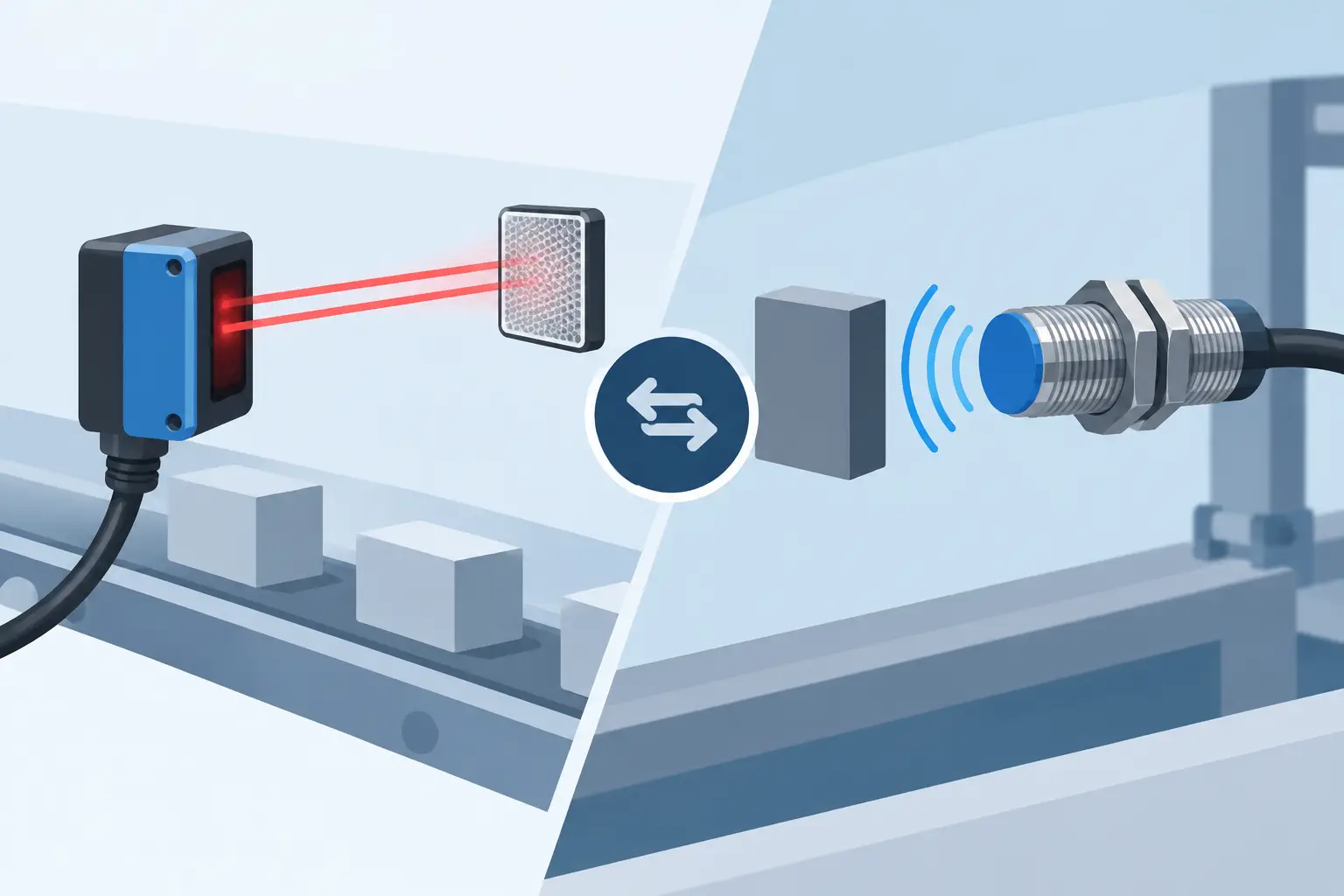
A stopped conveyor, a missed carton count, or a cylinder that will not confirm position often comes down to one small selection decision: photoelectric versus proximity sensing. Both technologies provide non-contact object detection, but they do not solve the same problems. Selecting by price or physical fit alone can create nuisance trips, inconsistent detection, and unplanned replacement work later.
For most industrial buyers, the practical comparison is between photoelectric sensors and inductive or capacitive proximity sensors. Photoelectric sensors use light. Inductive sensors detect metal through an electromagnetic field. Capacitive sensors can detect a wider range of materials, including plastics, paper, powders, and liquids, but are more sensitive to environmental changes. The target, required sensing distance, mounting conditions, and plant environment should drive the decision.
Photoelectric Versus Proximity: The Core Difference
A photoelectric sensor transmits light and evaluates the light that returns from, or is interrupted by, a target. Depending on the sensing method, it can detect objects from a few inches away to many feet away. This makes photoelectric technology a common choice for conveyor detection, pallet presence, carton counting, clear-object sensing, web-edge control, and long-range access or position monitoring.
An inductive proximity sensor creates an electromagnetic sensing field at its face. When a metallic target enters that field, the sensor switches. It does not require a visible target surface, reflector, or light path. Its sensing range is usually short, often measured in millimeters, but its performance is highly repeatable when the application involves a known metal target.
Capacitive proximity sensors work differently. They respond to changes in capacitance caused by a target entering the sensing field. They can identify nonmetallic materials, such as plastic resin, wood, glass, paper, grain, or liquid. That flexibility comes with a trade-off: moisture, buildup, material density, and changes in the surrounding environment can affect the switching point.
In a catalog or parts list, the term "proximity sensor" can mean several technologies. Confirm whether the installed device is inductive, capacitive, magnetic, ultrasonic, or photoelectric before ordering a replacement. The product family, sensing principle, output type, connector, and exact part number matter more than the generic product name.
When a Photoelectric Sensor Is the Better Fit
Choose photoelectric sensing when the target is too far away for an inductive sensor, when it is nonmetallic, or when the application requires detection without placing hardware close to the product path. Packaging lines are a familiar example. A photoelectric sensor can detect cartons, labels, trays, bottles, and wrapped products as they move through a machine without relying on a metal flag.
The sensing method matters as much as the sensor category. Through-beam sensors use a separate emitter and receiver. The target is detected when it blocks the beam. They generally provide the longest range and the strongest margin against differences in target color or surface finish. Their trade-off is installation effort: both sides of the sensing path need alignment and wiring.
Retroreflective sensors use a reflector opposite the sensor. They are easier to wire than through-beam models and work well for many conveyor applications. Polarized retroreflective versions are frequently used where shiny surfaces could cause false detection. Diffuse-reflective sensors detect light reflected directly from the target. They need no separate reflector, but target color, texture, angle, and background conditions have a greater effect on performance.
Background suppression photoelectric sensors are useful when the machine must detect an item at a defined distance while ignoring a fixed surface behind it. This can be effective for detecting products on conveyors or bins in front of a machine frame. Clear-object sensors address another common problem: transparent bottles, film, and glass can be difficult for standard diffuse sensors because they do not return light consistently.
Photoelectric sensing has limitations. Dust, oil mist, washdown residue, misalignment, and damaged lenses can reduce available signal. A sensor that works during startup may become unreliable after weeks of production if its optical path has not been considered. In dirty areas, specify adequate excess gain, select the correct sensing method, and make lens cleaning part of routine maintenance.
When Proximity Sensing Is the Better Fit
Inductive proximity sensors are typically the first choice for confirming a metal machine component at close range. They are widely used to detect actuator position, gear teeth, metal carriers, fixture location, guard position, and the presence of stamped or machined parts. Because they do not depend on light, they tolerate dark targets, bright targets, oily surfaces, and many contaminated industrial environments better than an optical sensor.
An inductive sensor is not a universal answer. Its nominal sensing distance is based on a standard steel target. Aluminum, stainless steel, brass, and copper can reduce the effective sensing range, sometimes significantly. If the target material is not ferrous steel, check the manufacturer’s correction factors and verify the actual switching distance in the installed geometry.
Flush and non-flush mounting also affect performance. A flush-mounted inductive sensor can be installed level with a metal bracket, but it usually has a shorter sensing range. A non-flush model offers more range but requires clearance around the sensing face to prevent the surrounding metal from changing its behavior. Replacing one style with the other without reviewing the mounting location can lead to constant output or a sensor that never switches.
Capacitive sensors are valuable when a photoelectric sensor cannot reliably see the material and an inductive sensor cannot detect it. A hopper level application is one example. The sensor may detect plastic pellets, powder, or liquid through a nonmetallic vessel wall. However, material buildup and humidity can shift sensitivity. Adjustable models should be set under normal operating conditions rather than on an empty, clean machine.
Compare the Application, Not Just the Sensor Body
A photoelectric and an inductive sensor may both fit an M18 threaded barrel mount, use 24 VDC, and provide a PNP output. That does not make them interchangeable. Before selecting a replacement or specifying a new device, define what the sensor must detect and what can interfere with detection.
Start with the target. Is it metal, plastic, paper, clear film, liquid, or a mixed product stream? Is its position repeatable? Does its surface vary by color, finish, or moisture? An inductive sensor is usually the dependable choice for a close-range steel target. A through-beam photoelectric sensor is often better for reliably counting a wide range of products. Capacitive sensing may be appropriate for material presence where neither light nor metal detection is practical.
Then consider distance and access. A photoelectric sensor can keep hardware away from a moving object, while an inductive sensor generally needs close proximity to its metal target. On a machine with limited adjustment room, the published sensing distance is not enough. Allow for vibration, bracket flex, target movement, and the reduction in range caused by nonstandard target materials.
Environmental exposure deserves equal attention. Inductive sensors are commonly preferred near coolant, chips, and oil. Photoelectric sensors can operate reliably in demanding facilities, but their lens condition and alignment must remain stable. For food, beverage, or washdown equipment, evaluate enclosure ratings, housing material, connector sealing, cable jacket compatibility, and cleaning chemicals. An IP rating alone does not answer every washdown question.
Electrical compatibility is another frequent source of avoidable rework. Confirm supply voltage, PNP or NPN output, normally open or normally closed logic, connector type, cable length, load current, response time, and PLC input requirements. A replacement that detects correctly but has the wrong output logic can stop a machine just as effectively as a failed sensor.
Procurement Details That Prevent Wrong-Part Orders
For maintenance replacements, record the complete label information before removing the failed sensor. The manufacturer, exact model number, sensing method, sensing range, output configuration, connection style, housing dimensions, and mounting type should all be captured. A photo is useful, but it should support - not replace - the part number and technical details.
If the original model is obsolete or unavailable, compare the replacement against the installed application rather than matching only the barrel diameter. A substitute may require a different mounting bracket, mating connector, teach procedure, or PLC input configuration. For photoelectric products, verify the sensing mode and whether a reflector or separate receiver is required. For inductive products, verify flush versus non-flush installation and the target material.
Standardizing approved sensor families can reduce future downtime. Many plants keep common M8, M12, rectangular, and fiber-optic sensor configurations in stock, but spares should reflect actual installed equipment. Maintaining a record of proven manufacturer series from suppliers such as Sick, Keyence, Omron, IFM, Allen-Bradley, or Schneider Electric helps purchasing source compatible replacements without restarting the evaluation process during an outage.
The better choice is usually clear once the application is described precisely. Use photoelectric sensing when distance, nonmetal targets, or product detection drive the requirement. Use inductive proximity sensing when a metal target must be detected close to the sensor with consistent performance in a demanding machine environment. When the application falls between those cases, test the sensor under real production conditions before making it the standard replacement.