
Servo Drive Replacement for Legacy Equipment
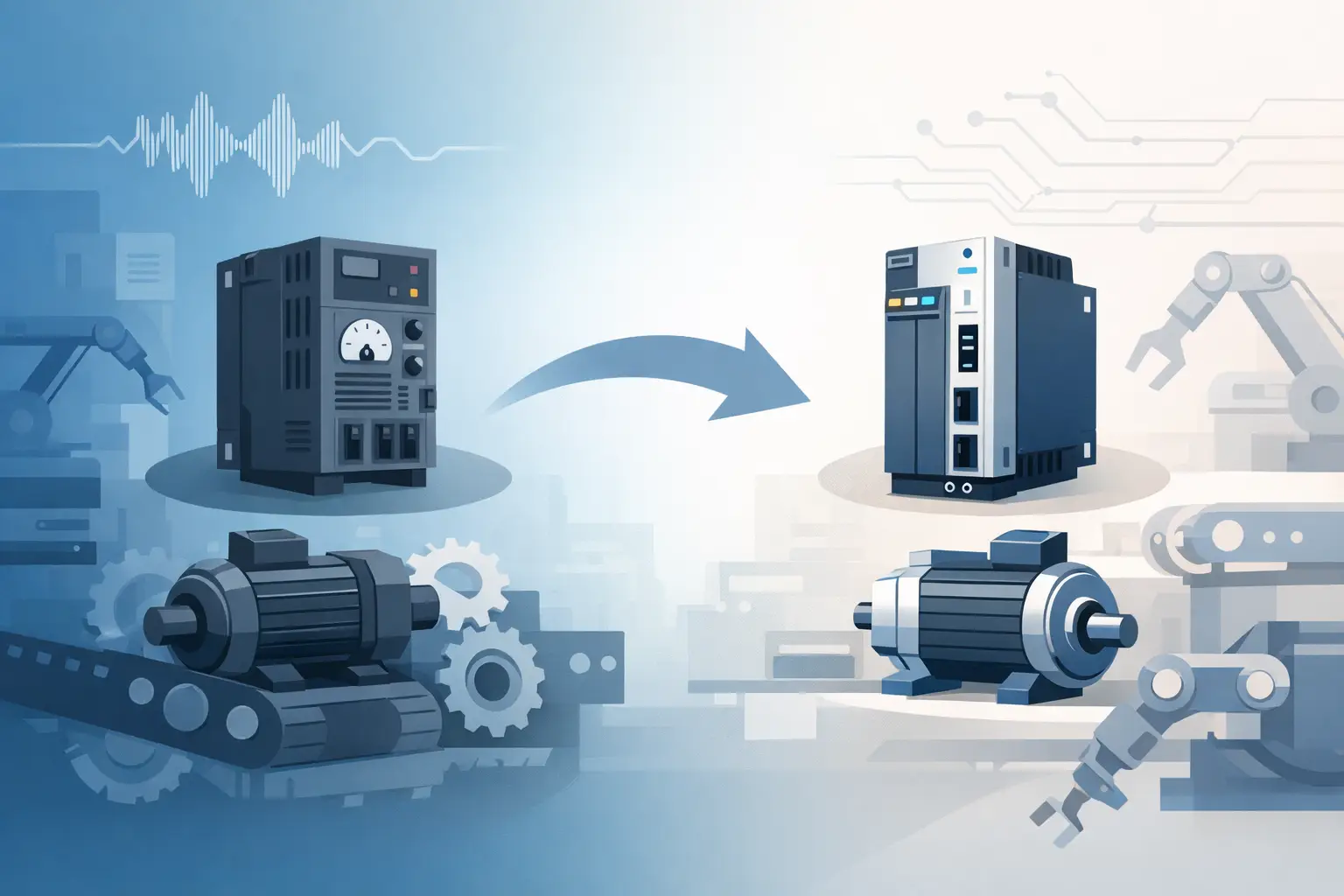
When a servo drive fails on an older machine, the problem is rarely limited to one bad component. Production stops, support documentation is often incomplete, and the original part may already be obsolete. That is why servo drive replacement for legacy equipment usually becomes a broader decision about uptime, compatibility, and how much of the machine you want to disturb.
For maintenance teams and controls engineers, the goal is not to modernize for its own sake. The goal is to get the machine back into service with the least risk to throughput, safety, and long-term support. In some cases, that means finding the same drive family or a direct replacement. In others, it means evaluating a newer compatible platform and planning for some level of rework.
What makes legacy servo drive failures difficult
Older servo systems tend to be tightly matched. The drive, motor, encoder, feedback cable, controller, and machine tuning were often selected as a package. Once one part drops out of the market, replacement becomes more complicated than swapping a power supply or contactor.
A failed legacy drive can raise several questions at once. Is the motor still healthy? Does the feedback device use a resolver, incremental encoder, or proprietary absolute protocol? Is the command interface analog, pulse train, fieldbus, or a vendor-specific network? Can the controller still communicate with a newer drive, or will the controls layer need changes too?
This is where many replacement projects go sideways. Buyers focus on voltage and horsepower first, which matters, but those are only the starting points. If feedback format or communication method does not line up, the drive may not be a practical drop-in even if its power rating looks correct on paper.
Servo drive replacement for legacy equipment starts with identification
Before sourcing options, confirm exactly what is installed now. The original drive model number is the obvious first step, but it is not enough by itself. Legacy equipment often includes field modifications, replacement motors from earlier repairs, or control cabinets that no longer match the machine drawings.
Start with the drive nameplate, motor nameplate, encoder or resolver details if visible, input voltage, output current rating, and any communication module part numbers. Record the PLC or motion controller platform as well. If the machine uses a standalone motion card, note that model number too.
It also helps to document symptoms before failure. A hard fault after power-up points in a different direction than intermittent overcurrent trips, overheating, or axis instability. If the motor or mechanical load caused the original failure, replacing only the drive may put the new unit at risk immediately.
Photos of terminal wiring, connector orientation, DIP switch settings, and cabinet layout can save hours later. For procurement teams, this level of detail also reduces back-and-forth during quoting and helps avoid ordering a close match that is not actually compatible.
When a direct replacement makes the most sense
If the machine is critical, validated, or difficult to retune, a direct replacement is usually the lowest-risk path. This is especially true on packaging lines, converting equipment, process skids, and OEM machinery where cycle timing matters and controls changes can create new downtime.
A direct replacement is ideal when the existing motor is known to be good, the mechanical system is stable, and the drive family can still be sourced. Even if the part is from an older product line, staying within the same series may preserve connector compatibility, parameter structure, and feedback support.
The benefit here is not just speed. It also limits commissioning variables. Maintenance teams can often restore operation with the original settings or a backed-up parameter set, rather than re-engineering the axis. For plants with lean staffing, that matters more than the appeal of a full controls refresh.
When retrofit is the better choice
There are times when replacing like-for-like no longer makes economic sense. If the old drive is difficult to source, lead times are inconsistent, or the rest of the motion package is already at end of life, continuing to chase obsolete parts can turn one repair into a repeating problem.
A retrofit may be the better path when multiple axes are aging at once, when the machine has recurring support issues, or when communication requirements have changed. Newer drives can offer better diagnostics, easier tuning, and more stable availability, but they usually require more engineering effort up front.
That trade-off is straightforward. A direct replacement generally lowers immediate downtime risk. A retrofit can improve long-term supportability, but only if the project includes proper evaluation of motor compatibility, feedback conversion, command interface, cabinet space, thermal load, and commissioning time.
Key compatibility points to check
Motor and feedback matching
This is often the make-or-break issue in servo drive replacement for legacy equipment. A newer drive may not accept the existing motor feedback device, even if motor voltage and current seem suitable. Resolver-based systems, proprietary encoder formats, and older absolute feedback types are common obstacles.
If the motor is mechanically sound but feedback is incompatible, you may be looking at a motor-drive package replacement rather than a drive-only repair. That affects mounting, couplings, inertia matching, and machine downtime.
Command and communication interface
Older machines may use +/-10 V analog commands, pulse references, serial motion networks, or brand-specific buses. Some modern drives still support these methods, while others are built around Ethernet-based motion only. If the upstream controller cannot command the new drive natively, additional hardware or software changes may be required.
Electrical and panel fit
Input voltage class, regeneration method, braking resistor requirements, fuse sizing, and heat dissipation all need review. A replacement drive that fits electrically but not physically can still delay the repair. Legacy cabinets were not designed with universal mounting patterns in mind.
Parameters and tuning
Even within the same brand, parameter mapping can vary by generation. If no backup exists for the failed drive, expect additional startup time. Machines with high-speed indexing, registration, or coordinated motion are less forgiving than basic positioning axes.
Procurement mistakes that add downtime
The most common error is ordering by partial description rather than exact part identification. "Yaskawa 2 kW servo drive" or "Allen-Bradley servo amplifier" is not specific enough for legacy replacement work. Series, suffix, feedback type, firmware considerations, and communication options all matter.
Another frequent problem is treating availability as the only decision factor. A drive that ships quickly but triggers motor replacement, cable changes, and controller edits may not shorten downtime at all. Fast procurement works best when matched with accurate technical verification.
It is also common to overlook adjacent components. If a drive failed because of damaged motor leads, contaminated encoder connections, poor cabinet cooling, or unstable incoming power, the replacement may fail early. Smart buyers check the surrounding hardware before putting a new unit into production.
How to approach sourcing without wasting time
For buyers under pressure, the best process is simple. Start with the exact model number, then verify whether you need an identical replacement, a manufacturer-approved successor, or a broader retrofit path. Have motor data, controller details, and application basics ready before requesting availability.
This is where a cross-brand supplier can be useful. Plants rarely operate on a single automation platform, and legacy support often crosses Siemens, Omron, Mitsubishi, ABB, Allen-Bradley, Yaskawa, Danfoss, and other manufacturers in the same facility. Working through one source that understands exact part-number purchasing can reduce delays, especially when you need to compare options quickly. American Automation 24 fits that type of purchasing workflow.
For planned replacements, it is worth buying before failure rather than after it. If a machine depends on an obsolete servo family and has no practical redesign budget this quarter, carrying a critical spare is often the lowest-cost insurance available.
A practical standard for replacement decisions
If the machine is high value, the process is stable, and an exact or near-direct part is available, keep the change small. If the drive family is fading out, support is inconsistent, or multiple motion components are at risk, evaluate a staged retrofit before the next failure forces the issue.
The right answer depends on how your plant values downtime versus engineering time. Some lines need the fastest possible restoration. Others justify a broader update because repeated emergency sourcing is already costing more than a controlled replacement plan.
A good servo replacement decision is not the one with the newest technology. It is the one that gets the axis back under control, fits the machine you actually have, and leaves you with a support path you can live with next year.