
Siemens PLC vs Omron: Choosing the Right Platform
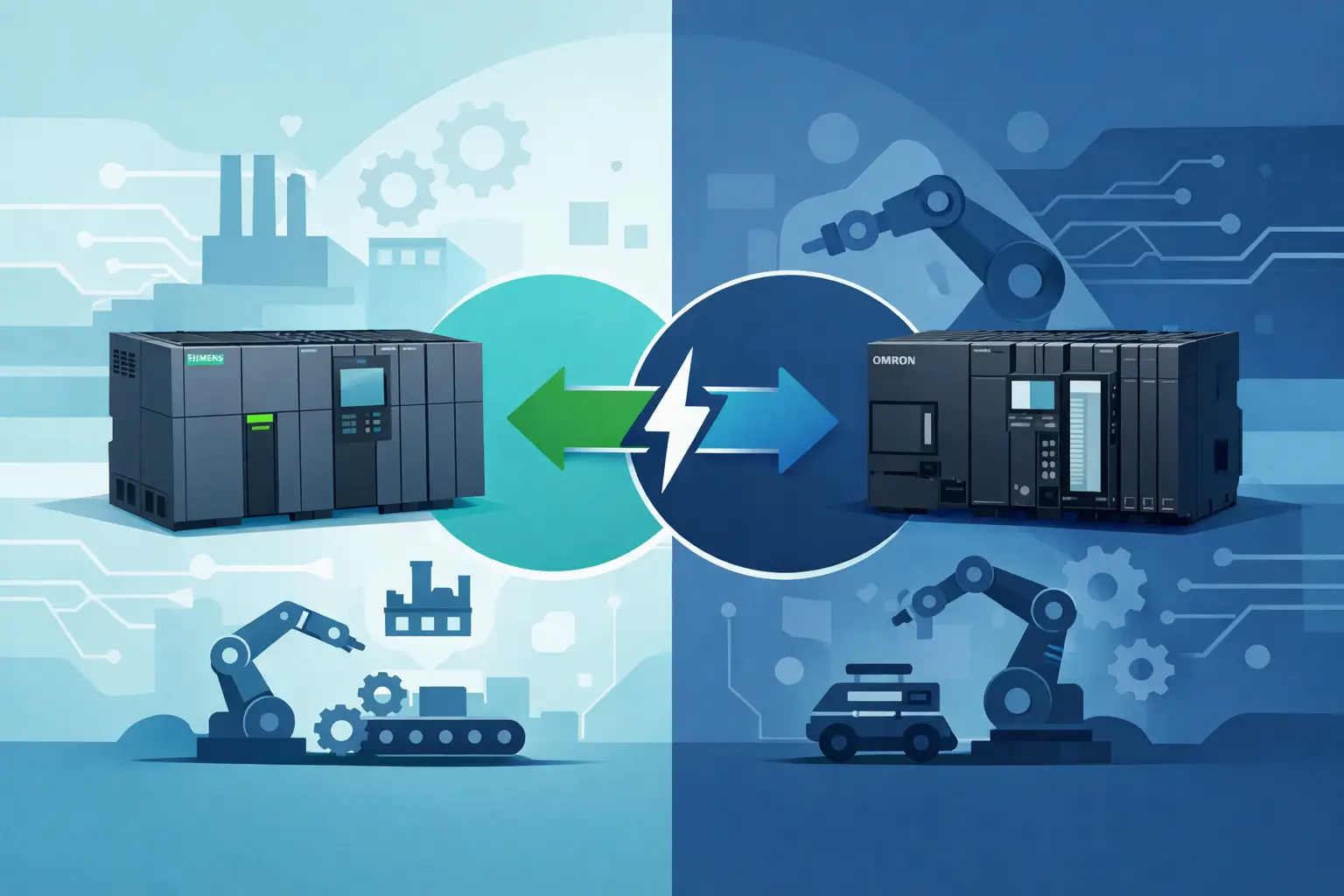
A failed PLC does not create a theoretical purchasing decision. It stops a packaging cell, conveyor zone, pump skid, or assembly station until the correct replacement is identified and installed. In a Siemens PLC vs Omron comparison, the right answer is usually driven less by a feature checklist than by the installed base, required network, engineering tools, and time available to restore production.
Both manufacturers supply capable control platforms used across machine building and industrial operations. Siemens is commonly selected where SIMATIC standards, PROFINET networks, and TIA Portal engineering are already established. Omron is frequently specified for compact machine control, EtherCAT-based motion applications, and systems built around the Sysmac platform. Neither brand is a universal substitute for the other.
Siemens PLC vs Omron at a Glance
Siemens and Omron overlap in core PLC functions: discrete and analog I/O, communications, PID control, safety options, motion coordination, remote I/O, and HMI integration. The practical differences appear when a plant must support a particular software environment, communications architecture, or legacy hardware family.
| Decision area | Siemens PLC | Omron PLC | |---|---|---| | Common engineering environment | TIA Portal for current SIMATIC families | Sysmac Studio for NJ/NX platforms; CX-Programmer for many legacy families | | Common industrial network focus | PROFINET and PROFIBUS in established installations | EtherCAT for motion-oriented systems, plus EtherNet/IP and other supported networks | | Typical platform range | S7-1200, S7-1500, ET 200 distributed automation, legacy S7 families | CP, CJ, CS, NX, NJ, and NX1P families | | Strong fit | Standardized plant control and multi-vendor network environments | Compact machines and coordinated motion applications | | Replacement priority | Match CPU, firmware, modules, and configured network role | Match CPU family, I/O bus, program software, and installed motion topology |
This is a directional comparison, not a compatibility chart. A CPU can be technically capable while still being a poor replacement if the existing program, rack, remote I/O, drives, HMI, or safety configuration cannot be migrated within the outage window.
Start With the Installed System, Not the Brand Preference
For a failed component, the first question is not whether Siemens or Omron is better. It is whether the machine needs an exact replacement. If an S7-300 CPU, Omron CJ-series CPU, communication card, or specialty I/O module has failed, replacing it with another controller family can turn a maintenance repair into a controls redesign.
Capture the full manufacturer part number from the label, including suffixes, voltage variants, communication ports, firmware information, and revision markings. Then identify the associated hardware: power supply, CPU, memory card, local and remote I/O, communication modules, HMI, servo drives, safety relays or safety PLCs, and field devices.
A controller replacement can also require access to the current project file and the correct engineering software version. If those files are unavailable, a direct like-for-like replacement may be the only reasonable way to return the equipment to service quickly. This is especially relevant in facilities with older SIMATIC S7-200, S7-300, S7-400, Omron CP, CJ, or CS installations.
Engineering Software Changes the Real Cost
PLC hardware cost is only one part of platform selection. Engineering time, licensing, technician familiarity, documentation, and future support can carry more weight over the life of a machine.
Current Siemens S7-1200 and S7-1500 systems are generally engineered in TIA Portal. For organizations that already maintain TIA Portal standards, libraries, diagnostic procedures, and trained personnel, staying with Siemens reduces onboarding and support friction. Siemens is also often a natural fit when a plant has a large PROFINET footprint and standardized SIMATIC HMI, drive, and remote I/O equipment.
Omron's Sysmac Studio is designed around the NJ and NX controller families and supports a coordinated approach to logic, motion, safety, and related machine components. For OEMs and integrators building EtherCAT-based machines, that unified engineering model can be a strong advantage. Older Omron systems may use CX-Programmer and related CX-One tools, so teams should confirm the software required before ordering a replacement CPU.
Do not assume a newer PLC will open, convert, or execute an existing project without engineering work. Program conversion may involve addressing changes, instruction differences, network configuration, HMI updates, safety validation, and commissioning time. That work can be justified during a planned modernization, but it is rarely ideal during an unplanned production outage.
Communications and Motion Are Often the Deciding Factors
A Siemens PLC vs Omron decision becomes clearer when the machine's network architecture is mapped. Siemens is deeply associated with PROFINET in many manufacturing facilities, while Siemens systems may also be found on PROFIBUS installations that remain in service. If the machine depends on specific Siemens remote I/O, intelligent devices, drives, or a PROFINET topology already validated by the plant, continuity usually favors Siemens.
Omron is particularly common in applications where EtherCAT coordinates servo axes, distributed I/O, vision, and high-speed machine functions. NJ and NX platforms are regularly evaluated for packaging, assembly, inspection, and material-handling equipment where synchronized motion matters. Omron also supports other industrial communication methods across its product range, but supported protocols vary by controller, module, and application.
Network names alone are not enough to make the call. Confirm the exact controller's port configuration, licensed functions where applicable, scan-time needs, node count, safety requirements, and device compatibility. A PLC that has the right network port may still lack the performance or function blocks needed by the machine.
Scale the Controller to the Job
For straightforward local control, a compact PLC can be the correct and economical choice. Siemens S7-1200 and Omron CP or NX1P-series controllers are often considered for smaller machines, basic sequencing, modest I/O counts, and limited communications requirements. The right model depends on program size, expansion needs, environmental requirements, and the devices it must control.
For larger machines or plant sections, Siemens S7-1500 and Omron NJ/NX systems offer broader capacity and more advanced options. The selection should account for remote I/O architecture, safety design, motion axes, data collection, HMI requirements, future expansion, and maintenance expectations. Buying additional capacity can make sense, but only when it supports a defined requirement. Oversizing a controller does not compensate for mismatched modules, missing project files, or unsupported network devices.
Plan Modernization Separately From Emergency Repair
Legacy controls eventually require a lifecycle plan. A planned migration from an older Siemens or Omron platform can improve diagnostics, spare-parts strategy, cybersecurity posture, and standardization. It also creates an opportunity to document wiring, clean up code, verify safety circuits, and update operator interfaces.
That is different from replacing a failed part at 2 a.m. During an emergency repair, the primary objective is controlled recovery: obtain the correct component, restore the known configuration, test the machine, and return it to production. During a planned upgrade, the objective is a validated future state. Combining both objectives without adequate schedule and engineering resources increases risk.
Plants with mixed equipment do not need to force every line into one PLC brand immediately. A practical strategy is to standardize new builds where it makes operational sense while maintaining a controlled spare-parts plan for existing Siemens and Omron systems. Standardization should reduce support burden, not create avoidable retrofit projects.
What to Verify Before Ordering a PLC or Module
Before placing an order, verify the exact part number and whether the item is a CPU, power supply, I/O module, communication card, memory component, or accessory. Confirm voltage, I/O type, rack or base-unit compatibility, connector requirements, and any installed expansion modules.
For CPUs, check the firmware revision, memory card requirements, communication configuration, and project backup. For I/O, confirm channel count, signal range, sink or source requirements, isolation needs, and terminal or connector style. For safety components, verify the safety architecture and follow the required validation process after installation.
It is also worth checking the shipping requirement before the outage becomes critical. A part that is correct but unavailable when needed does not protect production. American Automation 24 can help buyers source exact Siemens and Omron automation part numbers across replacement, maintenance, and planned project needs.
The most useful next step is simple: document the installed part number and surrounding hardware before a failure forces the decision. That record gives maintenance, engineering, and purchasing a faster path to the right component when production cannot wait.